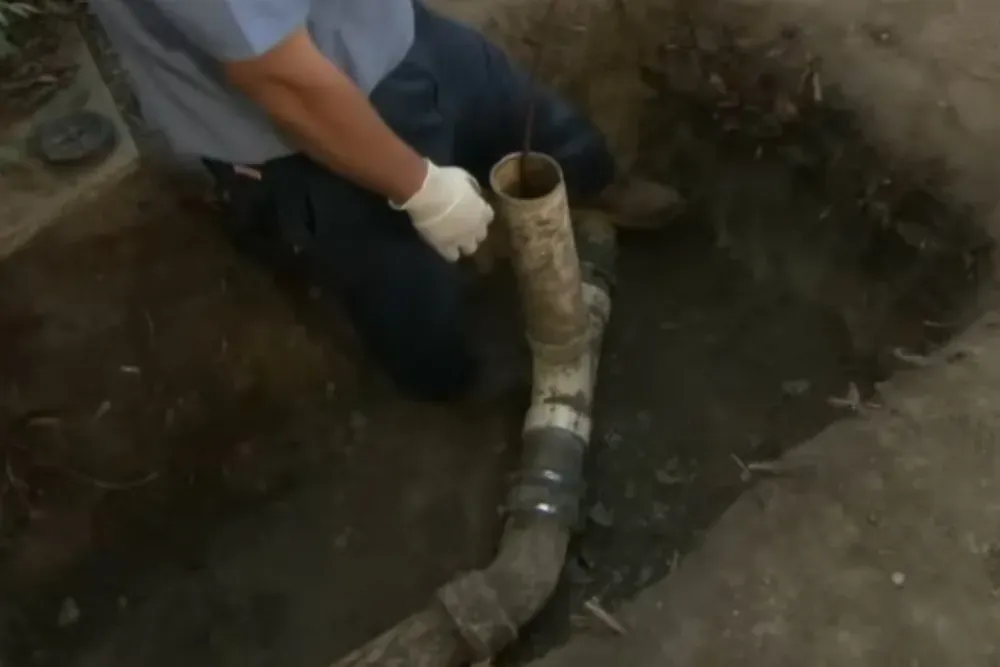
Why cast iron drains wear out
Cast iron is strong, quiet and fire resistant, which is why it was used for drains for so long. The weakness is corrosion. Wastewater, moisture and time eat at the inside wall, leaving a rough, scaled surface that catches debris and narrows the pipe.
A pipe can look fine from the outside while the opening has shrunk to a fraction of its original size. That is why many cast iron problems first show up as slow drains and repeat clogs, not as a leak.
Signs your cast iron drain is failing
None of these signs proves the pipe is bad, but together they are a strong reason to look. Watch for these:
- Slow drains in several fixtures, or backups that return after a cable has cleared them
- A sewage smell in the house, crawlspace or yard
- Rust stains, flaking or damp spots on exposed pipe
- Gurgling sounds when water drains elsewhere
- A wet or sunken patch in the yard above the line
Start with a camera, not a guess
The only reliable way to know the condition of a buried or hidden drain is to look inside it. A camera shows the scale, cracks, offsets and any section that has collapsed. It also shows where the problem sits, which decides how much needs to be fixed.
Our sewer inspection service records the pipe on video, so you can see what the plumber sees before you approve any repair.
Repair options for a cast iron drain
The right choice depends on how much of the pipe is bad.
| Option | Best when | Things to know |
|---|---|---|
| Spot repair | One cracked or failed section | The bad piece is cut out and replaced with a new section and couplings |
| Pipe lining | Scale or small cracks along a longer run | A resin liner is cured inside the old pipe. It is not suited to a collapsed pipe |
| Full replacement | Pipe is failing throughout | Highest cost and most disruption, longest fix |
| Cleaning only | Buildup without structural damage | Hydro jetting scours the wall. Results last if the pipe is sound |
Dealing with this right now? Call the line and describe what is happening.
Call (407) 964-8940Why cleaning alone sometimes backfires
Aggressive cleaning on a thin, corroded pipe can expose weak spots. That is why a camera check comes before any jetting on an old line. If the pipe is sound, cleaning is a good first step. If it is not, the plumber says so before anything is done.
What a repair involves
A spot repair on an accessible section is a short job. The plumber cuts out the bad section, fits new pipe with shielded couplings and tests the line. A slab line takes more work because concrete has to be opened.
For a larger repair, our sewer line repair page explains how lining, spot repair and replacement compare, and what to expect from each.
Questions to ask before you approve work
Ask to see the video, ask how much of the pipe is affected and ask what happens if you only fix the worst section. A good plumber will give you a plain answer and a written price. If a quote jumps straight to full replacement without showing you why, ask for the footage and a second opinion.
A simple plan if you suspect trouble
You do not have to decide everything at once.
- Note the symptoms. Write down which drains are slow and when the backups happen.
- Book a camera check. Seeing the pipe replaces guessing.
- Compare options. Ask for a spot repair price and a larger repair price.
- Plan the timing. If the pipe is failing but working, you may have time to schedule the fix.
- Keep records. Save the video and invoices for insurance and for a future sale.
Cast iron pipe and Apopka's older blocks
Apopka was chartered as a town in 1882 and incorporated as a city in 1919, so the older blocks near downtown include some of the city's oldest houses. The Apopka Museum's history page records the railroad arriving in 1885 and a nursery economy that grew through the 1920s. We cannot say what drain pipe any one of those houses has, so a camera check is how you find out.
The City of Apopka's website lists a building permit portal, so before a large repair you can check whether your address needs a permit. Ask the City of Apopka building division, and ask your plumber what is typical for the work.
Nearby we also serve Ocoee and Winter Garden.
Standards and sources. According to the state's rules, drain, waste and vent work is governed by the Florida Building Code, Plumbing, which is based on the International Plumbing Code. We name the standard so you can check it, and we leave section numbers to the permit office. Ask the City of Apopka building division what applies to your job.
Cast iron pipe questions from Apopka homeowners
Many last for several decades, and some far longer, but it depends on the water, the soil and how the pipe was installed. A camera check is the only way to know the condition of yours.
Often, if the pipe has not collapsed. Lining suits scale and small cracks along a run. The camera shows whether it fits.
No. It can come from a dry trap or a vent problem, but a persistent smell near the floor or yard deserves a camera look.
It depends on the work. Ask the City of Apopka building division before you start.
Older houses often do, but not always. A plumber can identify the pipe material during a visit.
Want a plumber to look at it? Call the line and describe what you see.
Call (407) 964-8940